In recent years, two-wheeler battery swapping, an efficient, low-carbon energy replenishment solution, has gained growing adoption across global markets. Deployment of battery swapping networks is accelerating, especially in emerging markets in Africa and Southeast Asia. Most of these regions lie within high-temperature and high-humidity climate zones, making environmental adaptability an inherent, unavoidable challenge for battery swapping operations from day one.
Meanwhile, climatic and environmental stressors — sustained heat, short-duration heavy rainfall, combined high heat and humidity, and localized grid volatility — are shifting from occasional anomalies to the new normal. For two-wheeler battery swapping operators, the industry is transitioning from scale-driven expansion to an in-depth development phase centered on operational quality. In this context, the quality of environmental adaptation, asset stability, and the business’s resilience against volatility will have a more direct bearing on costs and returns.
Drawing on years of project experience in two-wheeler battery swapping, Phoenicia has outlined operating strategies tailored to this climate and industry cycle for reference by peers.
Four Long-Term Impacts of the New Climate Normal on the Two-Wheeler Battery Swapping Industry
01|Sustained Heat Becomes Routine, Raising Burdens for Battery Thermal Management and O&M
High temperatures are no longer confined to mid-summer. Extended heat elevates the operating temperature of swap stations, imposing stricter requirements on battery thermal control, station heat dissipation and O&M support. In parts of China where high temperatures coincide with heavy power loads, operational pressure rises periodically during summer peak demand windows.
02|More Frequent Extreme Convective Weather Makes Station Flood Control a Permanent Priority
Sudden heavy downpours and severe convective weather create protection risks for low-lying and roadside swap stations. Such environmental disruptions are not isolated emergencies. Operators should integrate station flood control into annual business planning.
03|Combined Heat and Humidity Complicates Long-Term Equipment Maintenance
Hot and humid conditions gradually degrade cabinets, wiring harnesses and battery insulation components, acting as a latent risk factor that undermines equipment performance. Robust equipment protection design and full-lifecycle maintenance help preserve equipment service life and sustain long-term asset value.
04|Greater Climate Variability Complicates Unified Cross-Regional Operations
Variations in weather affect station availability, battery degradation and capacity supply. The traditional expansion-first model struggles to accommodate divergent climatic conditions across regions.
Five Operating Strategies for the New Climate Normal

01|Shift from Ad-Hoc Summer Protection to Year-Round Normalized Thermal Management
Operators are advised to move beyond seasonal protection thinking. Embed battery thermal control, station heat dissipation and asset planning into year-round risk control frameworks, establishing a maintenance cadence of quarterly rolling reviews and annual comprehensive assessments.
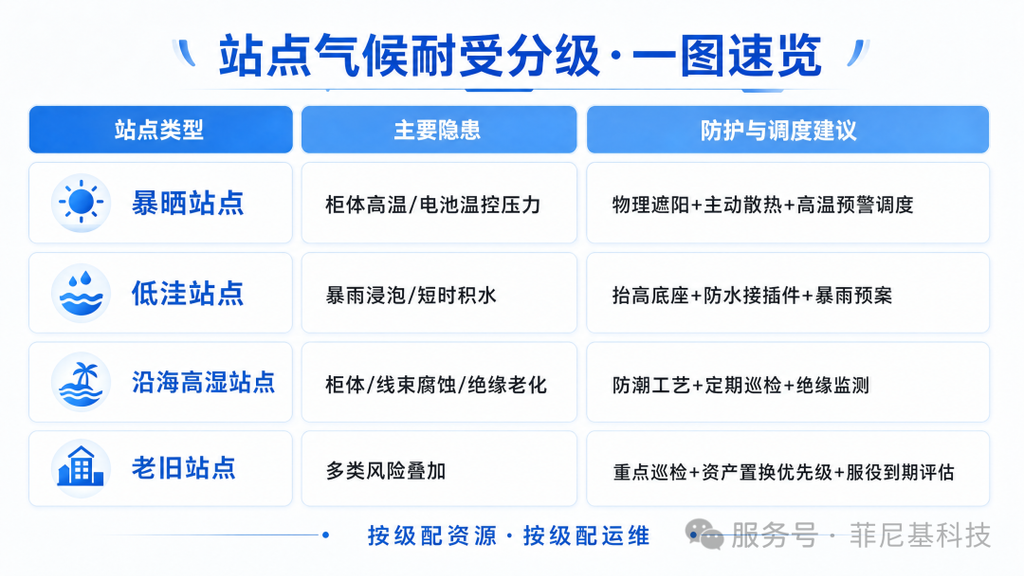
02|Shift from One-Size-Fits-All Management to Tiered, Differentiated Station Maintenance
Stations differ widely in environmental tolerance. Only differentiated protection, targeted investment and optimized dispatching can allocate resources where they deliver the greatest value. A tiered classification framework is recommended as follows:
Once classified, O&M, spare parts allocation and inspection schedules can be resourced by tier instead of spreading resources evenly across all sites.
03|Shift from Reactive Failure Response to Proactive Climate Forecasting
Reactive emergency repairs tend to inflate O&M costs. Proactive forecasting based on climatic cycles and regional characteristics, paired with advance planning and pre-emptive optimization, reduces business disruptions triggered by environmental changes.
For example: in hot-humid southern China, inspection, servicing and parts replacement cycles can be scheduled ahead of seasonal shifts. In regions prone to heavy rain, flood remediation and emergency drills for low-lying stations can be completed in advance.
04|Prioritize Hot-Humid Conditions to Safeguard Battery and Equipment Asset Value
Humidity represents a hidden driver of asset depreciation in hot-humid South and East China. Operations can evolve from focusing merely on short-term functional integrity toward full-lifecycle asset value retention. Measures including moisture-proof engineering, periodic insulation testing and end-of-life evaluation mitigate long-term depreciation and stabilize asset worth.
05|Adapt to Regional Grid Variations for Flexible Operations
The peak-valley load profile of summer electricity demand also merits attention in heat-prone, high-load areas of China. Battery swapping operators with regional footprints can build dynamic grid-responsive flexibility to balance station safety, service continuity and power costs. This adaptive capability is even more critical in overseas markets with pronounced grid instability.
Three Core Focuses of Asset Stewardship
For the past several years, the industry has prioritized scale and site count. Going forward, competitive advantage will increasingly hinge on three dimensions:
- Climate adaptability of swap stations
- Asset value retention of batteries
- Business resilience amid volatility
It is important to note that climate factors introduce manageable operational variables rather than fundamental constraints on industry growth. As environmental adaptation, asset management and operational stability become new entry barriers, the industry will place greater emphasis on refined management. Operators with comprehensive, robust asset stewardship systems — regardless of their scale — stand better positioned to build competitive advantages amid this industry transition.
Conclusion

Industry operations will continue moving toward refined management. While climatic challenges raise operational complexity, they also drive rising demand for battery swapping hardware, platforms and full-lifecycle services. From a longer industrial-cycle perspective, the inherent strengths of two-wheeler battery swapping in energy replenishment efficiency, safety and user experience will keep unlocking value. For operators, investment in climate adaptation essentially converts environmental uncertainty into controllable operating expenditure — a core pillar of long-term competitiveness.
As a technology service provider for the two-wheeler battery swapping sector, Phoenicia leverages years of field experience to deliver climate-adaptable battery swapping systems and intelligent hardware. Our support extends to equipment protection design, smart thermal management and O&M dispatching.Phoenicia empowers operators to stabilize assets, secure reliable operations and protect returns. Together, we build a sustainable new-energy replenishment ecosystem.
 Phoenicia Tech. Co., Ltd.







Submit Product Inquiry
We Will Contact You Soon